If you run a D2C brand in India and someone asks you what your digital marketing strategy looks like, can you answer confidently? Many founders can name the channels — Instagram, Google, WhatsApp — but very few have a clear picture of how all these pieces fit together to build a profitable, scalable business.
That is exactly what this guide is for. We are going to break down digital marketing from the ground up, explain every major channel, and show you how each one maps to actual business outcomes — not just vanity metrics.
Whether you are just launching your Shopify store or you are scaling past ₹1 crore in monthly revenue, understanding digital marketing at this level of depth will change how you make decisions.
What Is Digital Marketing — Really?
Digital marketing is the use of internet-connected channels and platforms to reach, engage, and convert your target audience into paying customers. Unlike traditional marketing — hoardings, newspaper ads, TV commercials — digital marketing is measurable, targetable, and adjustable in real time.
For D2C (Direct-to-Consumer) brands specifically, digital marketing is not just a growth lever. It is the entire go-to-market engine. You do not have retail shelf space, distribution networks, or a sales team doing door-to-door visits. Your website, your ads, your content, and your automated communications are your storefront, salesperson, and loyalty programme all at once.
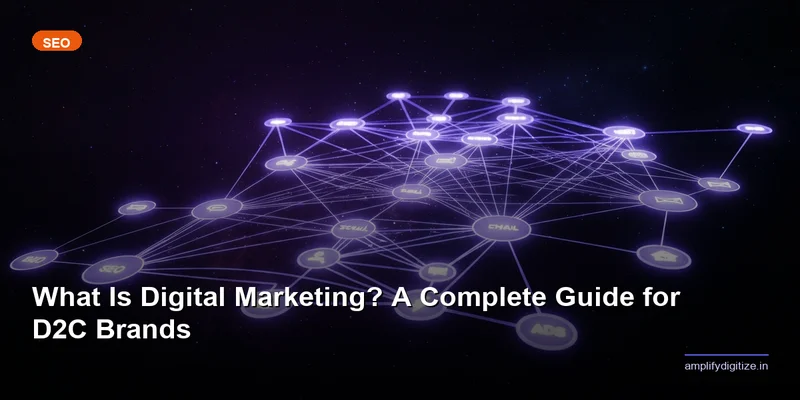
"Digital marketing for a D2C brand is not one thing. It is an ecosystem of touchpoints that work together to move a stranger into a loyal customer."
The Core Channels of Digital Marketing
Let us walk through each major digital marketing channel, what it does, and why it matters for D2C brands.
1. Search Engine Optimisation (SEO)
SEO is the practice of optimising your website and content so that it ranks higher on Google and other search engines when people search for products or topics related to your brand. For a D2C brand selling, say, ayurvedic skincare, ranking on the first page for queries like "best natural face serum India" can drive thousands of high-intent visitors every month — for free.
SEO includes:
- On-page SEO — optimising product pages, category pages, meta titles, and headings
- Technical SEO — site speed, mobile responsiveness, structured data, crawlability
- Content marketing — blog posts, guides, comparison articles that attract organic traffic
- Link building — earning backlinks from authoritative websites to build domain credibility
SEO is a long-term investment. It takes three to six months to see significant movement, but once it kicks in, it delivers compounding returns. If you want to understand how to optimise for the evolving search landscape, including AI-powered search, read our post on Optimising for AI-Driven Search Engines.
2. Performance Marketing (Paid Ads)
If SEO is a marathon, paid advertising is a sprint. Performance marketing refers to running paid campaigns on platforms like Google, Meta (Facebook and Instagram), and YouTube to drive targeted traffic and conversions. You pay only when a specific action happens — a click, a lead, a purchase.
For D2C brands, the most critical paid channels are:
- Meta Ads (Facebook and Instagram) — ideal for awareness, retargeting, and driving impulse purchases. Meta's interest and behavioural targeting lets you reach very specific audiences.
- Google Ads — captures high-intent search traffic. If someone searches "buy leather wallet online India," a Google Shopping or Search ad puts you right in front of them at the moment they are ready to buy.
- YouTube Ads — powerful for brand storytelling and product demonstrations, especially for beauty, wellness, and lifestyle categories.
The key metric in performance marketing is ROAS — Return on Ad Spend. A well-structured campaign that drives a 4x or 5x ROAS means for every ₹1 you spend on ads, you get ₹4 or ₹5 back in revenue. Achieving that consistently requires rigorous creative testing, audience segmentation, and bid strategy optimisation.
Want a detailed walkthrough of running profitable Facebook and Instagram campaigns? Check out our guide on How to Run Profitable Facebook Ads.
3. Social Media Marketing
Social media marketing goes beyond just running paid ads. It encompasses your organic presence — the content you post, the conversations you participate in, the community you build on platforms like Instagram, YouTube, LinkedIn, and increasingly, WhatsApp Channels.
For D2C brands, a strong organic social presence does several important things:
- Builds brand trust and authenticity before a customer ever visits your website
- Creates a retargetable audience for your paid campaigns
- Reduces customer acquisition cost over time as your following grows
- Provides social proof through user-generated content and community engagement
The challenge is that social media algorithms are constantly changing. What worked in 2022 may not work today. Reels, carousels, Stories, and long-form video all have different engagement profiles on different platforms. Our post on Social Media Marketing Algorithms 2026 breaks down exactly what is working right now.
4. WhatsApp Marketing and Automation
WhatsApp is where digital marketing in India gets uniquely powerful. With over 500 million active users in India, WhatsApp is not just a messaging app — it is a direct line into your customer's most personal communication channel.
Through the WhatsApp Business API, D2C brands can:
- Send automated abandoned cart reminders that recover lost revenue
- Run personalised drip campaigns after a purchase (onboarding, upsell, loyalty)
- Broadcast promotional messages to opted-in subscriber lists
- Provide real-time customer support through chatbots or live agents
WhatsApp messages see open rates of 90%+ compared to email's average of 20-25%. For Indian D2C brands especially, this channel is massively underutilised. If your brand is not yet using WhatsApp automation, you are leaving significant revenue on the table.
5. Email Marketing
Email might feel old-fashioned compared to WhatsApp and Instagram, but it remains one of the highest ROI channels in digital marketing. For D2C brands, email is the backbone of customer retention — turning a one-time buyer into a repeat customer.
Effective D2C email marketing includes:
- Welcome series — onboard new subscribers with brand story, key products, and a first-purchase discount
- Post-purchase flows — order confirmation, shipping updates, product education, and review requests
- Winback campaigns — re-engage customers who have not purchased in 60 or 90 days
- Seasonal and promotional broadcasts — sale announcements, new product launches, festival campaigns
A healthy email list is also an owned asset. Unlike your social media following, no algorithm change can take it away from you. That makes it invaluable for long-term brand resilience.
6. Conversion Rate Optimisation (CRO)
CRO is often left out of digital marketing conversations, but it arguably has the highest leverage of any channel. CRO is the process of improving your website and landing pages so that a higher percentage of visitors take the desired action — whether that is adding to cart, starting a trial, or completing a purchase.
Think about it this way: if your store converts at 1.5% and you spend ₹1,00,000 on ads to get 10,000 visitors, you get 150 orders. If you improve your conversion rate to 3% without changing your ad spend, you get 300 orders. You just doubled your revenue without spending a rupee more on traffic.
CRO tactics include A/B testing headlines and CTAs, improving page load speed, simplifying the checkout process, adding trust signals, and optimising product page copy and imagery. We have written extensively about this — see our post on Why CRO Is Crucial for E-commerce.
How Digital Marketing Channels Work Together
The biggest mistake D2C founders make is treating these channels as independent silos. In reality, the most profitable digital marketing strategies use these channels in combination, guiding the customer through a journey:
- Awareness — A potential customer discovers your brand through a Reels video, a Google search result, or a YouTube ad.
- Consideration — They visit your website, read a blog post, follow you on Instagram, or browse your product pages.
- Conversion — A retargeting ad or a WhatsApp message nudges them to complete their purchase.
- Retention — An email flow, a WhatsApp loyalty message, or a personalised offer brings them back for a second and third purchase.
- Advocacy — A happy customer shares a UGC post, leaves a review, or refers a friend.
Each channel plays a role in one or more of these stages. When you build your strategy, you should be asking: which channels do we use for each stage, and how do they hand off to each other?
Digital Marketing for D2C Brands in India — Key Considerations
Running digital marketing for an Indian D2C brand has its own nuances that global frameworks do not always account for:
Mobile-First Audience
Over 75% of ecommerce traffic in India comes from mobile devices. Every touchpoint — your Shopify store, landing pages, emails, and WhatsApp messages — must be designed for mobile first. A slow or poorly designed mobile experience kills conversions before they happen.
Festival-Driven Purchase Behaviour
Indian consumers spike their spending around Diwali, Holi, Eid, Navratri, and year-end sales. Your digital marketing calendar must anticipate these windows, with campaigns and offers planned well in advance. Brands that start Diwali campaigns in September consistently outperform those who scramble in October.
Vernacular and Regional Targeting
India is not one market — it is many. Meta Ads and Google Ads both support regional language targeting. Brands that speak to customers in Hindi, Marathi, Tamil, or Bengali often see significantly lower CPAs compared to English-only campaigns in those regions.
Cash on Delivery Still Matters
Despite UPI's growth, a significant portion of Indian ecommerce orders — particularly outside metro cities — still use COD. If your checkout or marketing does not account for this, you are losing customers in Tier 2 and Tier 3 cities who are ready to buy but uncomfortable with prepaid.
The Role of Your Shopify Store in Digital Marketing
All your digital marketing eventually leads back to one place — your website. For most D2C brands in India, that means a Shopify store. Your store is not just a product catalogue; it is the final conversion point for every rupee you spend on ads, every email you send, every organic visitor you earn through SEO.
A technically sound, fast-loading, and conversion-optimised Shopify store is a prerequisite for any digital marketing strategy to work. If your store loads in five seconds, has confusing navigation, and a checkout process with too many steps, you will bleed conversions no matter how good your ads are.
For practical tips on optimising your Shopify store for sales, read Top 10 Shopify Tips to Boost Sales. And if you want to understand how great web design supports your marketing, our post on Web Design Secrets That Make Your Brand Stand Out is worth your time.
How AI Is Changing Digital Marketing
Artificial intelligence is no longer a buzzword — it is actively reshaping how digital marketing is done. From automated bidding in Google Ads to AI-generated ad creatives, predictive customer segmentation, and AI chatbots on WhatsApp, brands that embrace AI tools are moving faster and spending more efficiently than those that do not.
For D2C brands, the most practical AI applications right now are in ad creative testing, personalised email and WhatsApp flows, product recommendations, and customer support automation. We explore this in depth in our post on How AI Is Shaping the Future of Digital Marketing.
Building Your Digital Marketing Strategy — Where to Start
If you are feeling overwhelmed by the breadth of digital marketing, here is a practical framework to get started without spreading yourself too thin:
- Fix your foundation first. Make sure your Shopify store is fast, mobile-optimised, and converting at a baseline rate before you invest heavily in driving traffic.
- Start with one paid channel. For most Indian D2C brands, Meta Ads is the best starting point for its targeting depth and visual nature. Master one channel before expanding.
- Set up your retention flows. Email and WhatsApp automations — welcome series, abandoned cart, post-purchase — should be live before you scale ad spend. Retention is where profit is made.
- Build content for SEO. Start a blog. Write about topics your customers are searching for. This compounds over time and reduces your dependence on paid traffic.
- Measure everything. Use Google Analytics 4, Meta Pixel, and your Shopify dashboard to track every channel's contribution to revenue. Make decisions based on data, not gut feel.
Final Thoughts
Digital marketing is not a single thing you switch on and watch work. It is a system — a set of interconnected channels, each playing a specific role in attracting, converting, and retaining customers. For D2C brands in India, getting this system right is the difference between a brand that grows predictably and one that is always chasing its next sale.
At Amplify Digitize, we work exclusively with D2C brands to build and scale these systems — from Shopify development and performance marketing to WhatsApp automation and CRO. If you want to understand where your brand stands and what to focus on next, the best place to start is a clear audit of what you are doing today and where the gaps are.
The brands that win in D2C are not necessarily the ones with the best products. They are the ones who build the most effective marketing systems around those products.